Why Shopify Stores Run Out of Cash (Even When Profitable)
Most Shopify stores don’t fail from lack of sales — they fail from cash timing mismatches. Learn how ad spend, inventory, payouts, and refunds impact your real cash position.
You check your Shopify dashboard: revenue is up, ROAS looks strong, and orders are coming in consistently. On paper, your business appears healthy—maybe even thriving.
But when it’s time to pay your supplier or scale ad spend, the cash simply isn’t there.
Most Shopify stores don’t fail because they lack revenue.
They fail because they run out of cash.
The issue is not profitability. It’s a structural mismatch between when cash leaves your business and when it actually arrives.
Quick Answer:
Shopify stores often run out of cash because payouts, ad spend, inventory purchases, and refunds occur on fundamentally different timelines. A store can generate highly profitable revenue while still experiencing severe liquidity pressure due to these structural operational timing mismatches.
Why do profitable Shopify stores experience cash timing mismatches?
Cash flow in ecommerce behaves very differently from revenue.
To understand why profitable stores run into trouble, look at the timeline of a typical transaction:
| Business Event | Cash Impact | Typical Timing |
|---|---|---|
| Inventory Payment | Cash Out | Day -30 (upfront or partial) |
| Meta/Google Ad Spend | Cash Out | Day 0–1 |
| Customer Places Order | Revenue Recorded | Day 0 |
| Shopify Payout Arrives | Cash In | Day 3–5 |
| Refunds / Chargebacks | Cash Out | Day 10–30 |
You are spending money to acquire and fulfill customers before you receive the actual cash.
That gap is where even fast-growing businesses break.
The 5 Hidden Cash Flow Traps in Shopify
1. How does Meta and Google ad spend create a cash flow illusion?
When campaigns are performing, scaling ad spend feels like the obvious move.
But platforms like Meta and Google charge your card immediately or within short billing cycles. Revenue from those ads, however, only reaches your account after Shopify processes payouts.
This creates a temporary but very real cash deficit.
Scaling ads without visibility into cash timing often leads to short-term growth—and unexpected cash shortages.
2. Why does inventory timing trap working capital?
Inventory requires upfront capital.
Whether it’s 30% upfront and 70% before shipping, or full payment before production, the cash leaves your account long before those goods generate revenue.
By the time inventory converts into sales and payouts, you may already be operating under constrained liquidity.
You become inventory-rich, but cash-poor.
3. How do structural Shopify payout delays impact liquidity?
Shopify payouts typically take 2–5 business days. Weekends, bank holidays, or account-level reviews can extend this timeline.
In some cases, payment providers introduce rolling reserves, temporarily holding a percentage of your revenue to mitigate risk.
This means your expected cash is not always available when you need it.
4. Why do delayed refunds silently kill ecommerce margins?
Returns and chargebacks don’t align with your revenue timeline.
A sale recorded today may be reversed weeks later. If that revenue has already been reinvested into ads or inventory, the refund creates a direct hit to your cash reserves.
This often happens quietly, without immediate visibility.
5. Why is scaling without cash flow visibility dangerous?
Many stores scale:
- ad spend
- inventory
- operations
based on revenue trends.
But without understanding future cash position, these decisions become risky.
The real question is not:
How much did we make?
It is:
How much cash will we actually have 30–90 days from now?
Why Spreadsheets Break at Scale
Most merchants try to solve this with spreadsheets.
They export data from Shopify, reconcile ad spend manually, estimate COGS, and attempt to model future cash.
This approach fails for three reasons:
- It is time-consuming and error-prone
- It quickly becomes outdated
- It cannot model real-world complexity (ads, payouts, refunds, inventory timing)
By the time the spreadsheet is updated, the situation has already changed.
See Your Cash Before It Happens
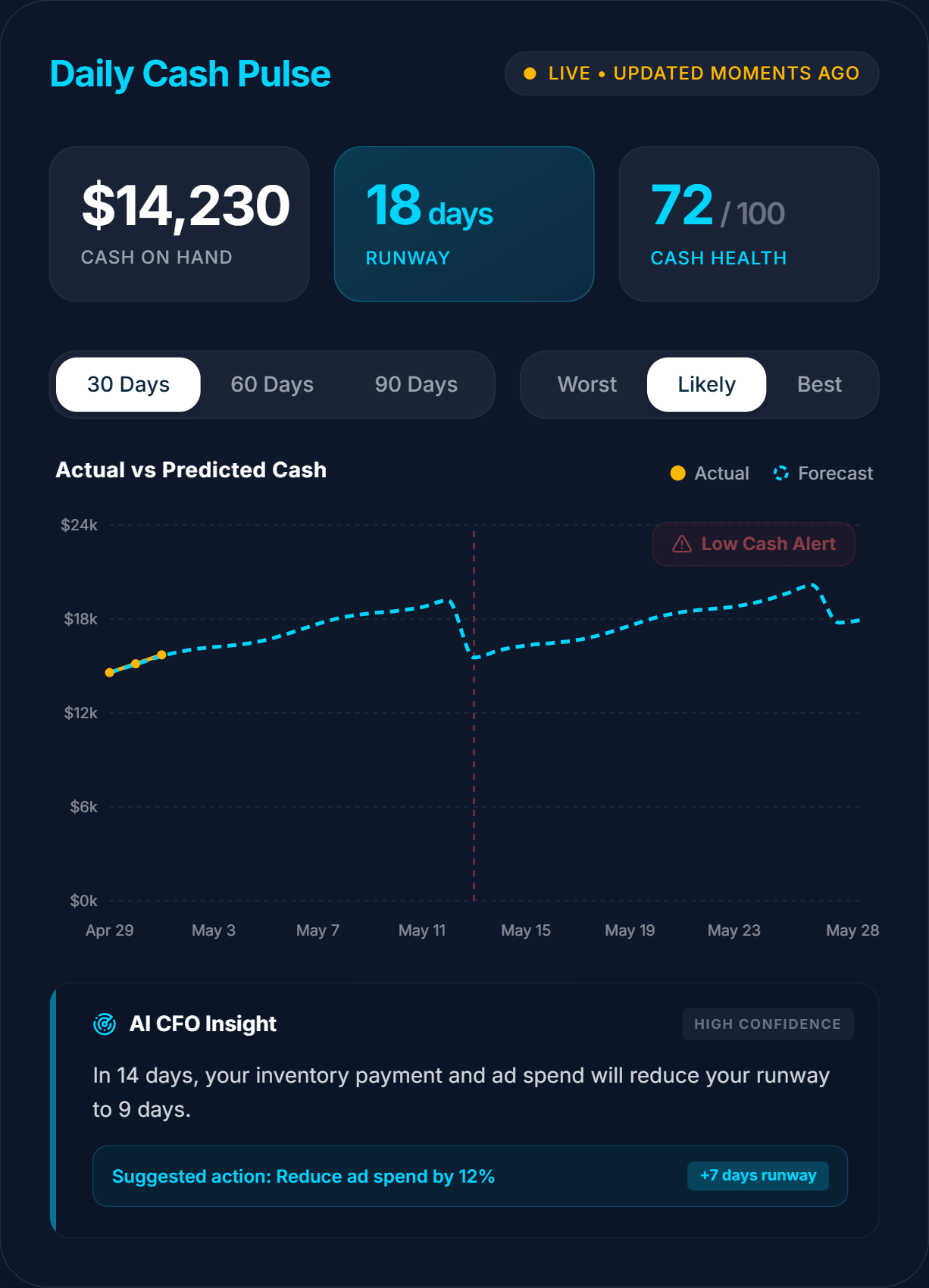
High-performing operators don’t rely on static reporting.
They forecast cash flow, simulate decisions, and identify risks before they occur.
If you want to understand how fast cash can change in your business:
👉 Try the Cash Risk Calculator to simulate real scenarios.
The Shift: From Guessing to Knowing
Most Shopify stores operate reactively:
- reacting to shortages
- adjusting too late
- relying on incomplete data
The best operators shift to a predictive model:
- anticipating cash dips
- planning inventory and ad spend
- maintaining runway visibility
Introducing an AI Approach to Cash Flow
This is the problem Cashvector is built to solve.
By connecting:
- Shopify orders and payouts
- ad platforms (Meta, Google, TikTok)
- refunds and inventory timing
it models your future cash position continuously.
Instead of discovering problems after they happen, you receive forward-looking insights:
In 18 days, your inventory payment and ad spend will reduce your runway to 9 days. Suggested action: Reduce ad spend by 12% to maintain a +7 day buffer.
This is the difference between reacting late and acting early.
Pricing Based on Real Value
Cashvector is designed around a simple idea:
👉 The more clearly you can see into your future cash position, the better your decisions become.
Explore how forecast depth and control scale with your business:
Get Early Access
We are currently onboarding a limited number of Shopify stores for private beta.
If you want to gain visibility into your cash before problems arise:
Final Thought
Revenue tells you how your business is performing.
Cash flow determines whether your business survives.
Most failures are not caused by lack of demand—but by lack of visibility into cash timing.
Fix that, and you fundamentally change how your business operates.
Atul Koshley
Founder, Cashvector
Software Engineer
Builder of Shopify Cash Visibility systems
See your cash before problems happen.
Stop steering your business by looking in the rearview mirror. Predict your Shopify cash flow 30–90 days ahead with AI.